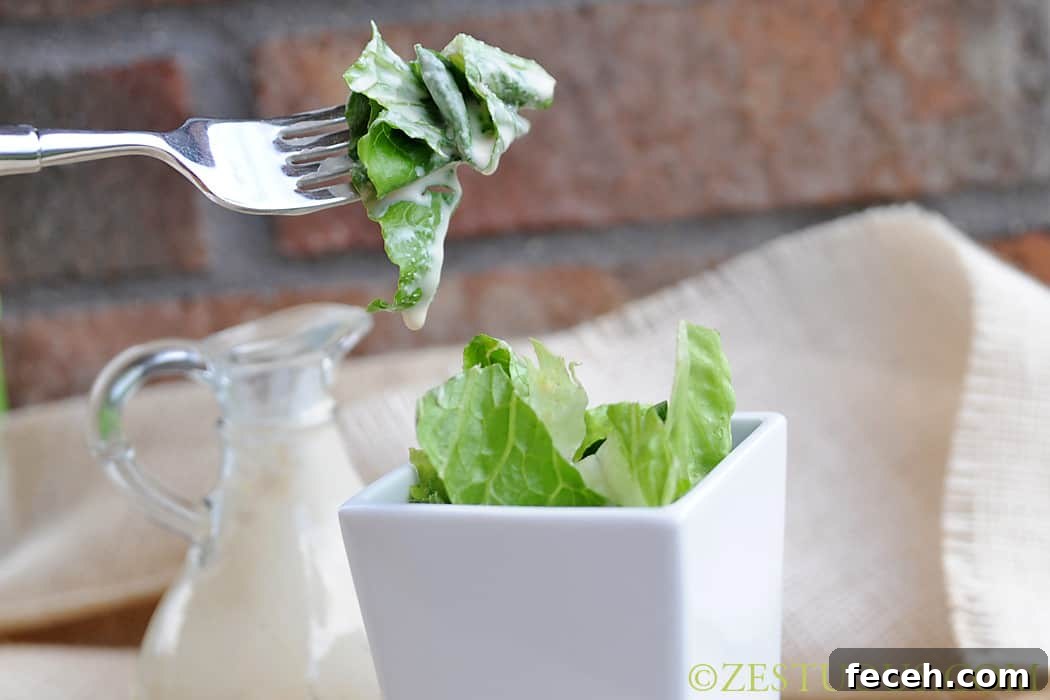
Creamy, 1-point dressing bursting with flavor, tang, and cheese.
This weekend I experimented in the kitchen to create a low-calorie Caesar dressing that still delivers on taste.
Caesar salads are simple and satisfying: romaine, Parmesan, croutons, and a bold, garlicky dressing. But classic Caesar dressing is often high in calories because oil is the primary ingredient in many full-fat versions.
When manufacturers reduce calories, oil gets replaced with water, real dairy is swapped for whey, and sugar can become high-fructose corn syrup. The result is a dressing that looks lighter on the label but tastes thin and processed.
If you’ve committed to eating healthier, bland lettuce can feel like punishment. Two tablespoons of typical restaurant-style Caesar dressing can be 150 calories—about the same as a small fried treat—so people often reach for reduced-fat or fat-free bottled dressings that compromise flavor for fewer calories.
This recipe offers a better solution: a flavorful Caesar-style dressing that’s only 25 calories per serving.
Contrary to its name, Caesar dressing wasn’t invented by Julius Caesar. The dressing dates to the 1920s and is attributed to Caesar Cardini, an Italian restaurateur who served it at his Tijuana restaurant. The original ingredients included fresh eggs, Parmesan, olive oil, garlic, lemon juice, vinegar, salt, pepper, and Worcestershire sauce.
Over the years the classic has been tweaked many times, and I’m willing to adapt it further to cut calories without sacrificing taste.
I avoid raw eggs unless they’re farm-fresh, but pasteurized liquid eggs (sold in cartons) are an easy, safe substitute. Parmesan remains essential for that salty, bitter backbone that defines Caesar dressing. Garlic, lemon juice, Worcestershire, salt, and pepper add big flavor with almost no calories. The challenge is replacing the olive oil, which normally creates the creamy, emulsified texture.
Instead of using a high-fat mayonnaise or oil, I chose plain Greek yogurt for creaminess. Greek yogurt adds body, tang, and protein while keeping calories and fat low. It’s thick and rich, and when combined with the traditional Caesar flavorings, it creates a satisfying dressing that doesn’t feel like a diet compromise.
For my version, I swapped the oil for 0% Greek yogurt. The nutritional difference is dramatic: a conventional Caesar dressing serving might contain roughly 150 calories and 16 grams of fat, whereas this Greek-yogurt-based version provides about 25 calories and only 0.5 grams of fat per serving, while delivering around 3.5 grams of protein.
Despite being very low in calories, this dressing tastes authentic and creamy—no wasted calories on bland substitutions.
Saved
Pin
25-Cal Caesar Dressing
Ingredients
- 8 oz Fage 0% Greek yogurt
- 2 tablespoons Egg Beaters (or pasteurized liquid egg)
- 2 tablespoons grated Parmesan cheese
- 1 tablespoon lemon juice
- 1 tablespoon champagne vinegar
- 1 tsp. chopped garlic (packed in oil or fresh)
- 1 ½ tsp. Worcestershire sauce
- ½ tsp. salt
- ½ tsp. Dijon mustard
- 1/8 tsp. black pepper
Instructions
-
Place all ingredients in a bowl and whisk until smooth and well combined.
-
Taste and adjust seasoning if needed. Serve over romaine with additional grated Parmesan and croutons.
Nutrition
Nutrition information is automatically calculated and should be used as an approximation.